
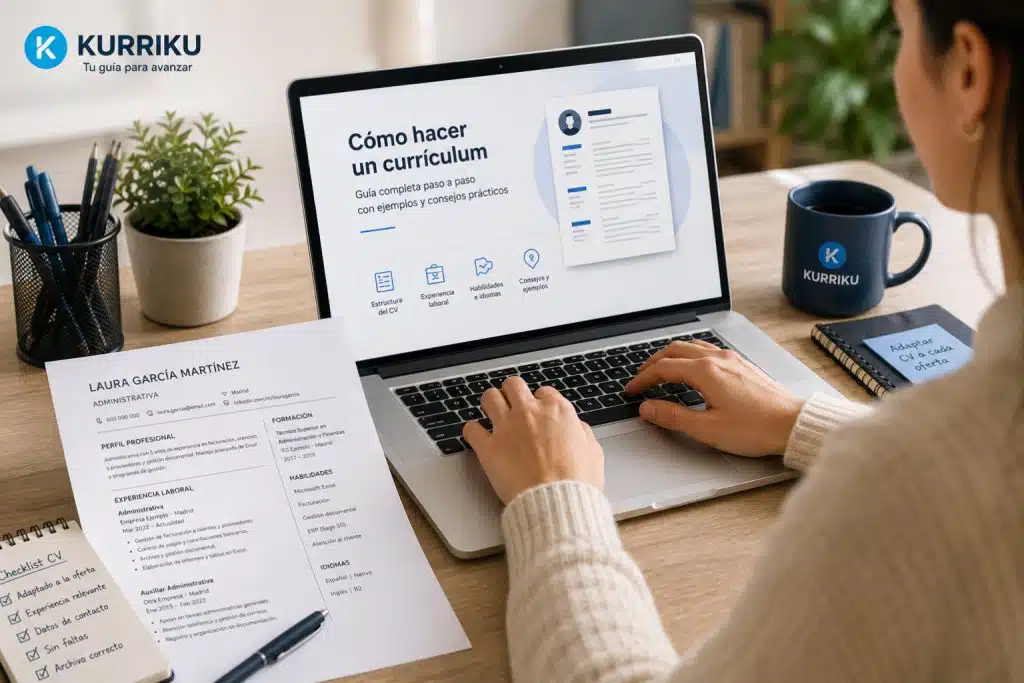
Learning how to write a CV is not about filling in a template with your entire work history. A good CV selects the information that helps an employer quickly understand what you can do, what experience you have and why you could be a good fit for the role.
There is no perfect CV for every job vacancy. The most effective approach is to have a strong master CV and tailor it each time you apply for a job.
The most important point: do not try to tell your whole story. Select what is most useful for the role you want and present it clearly, concisely and in an easy-to-read format.
What a good CV should achieve
The aim of a CV is not to get you the job directly. Its first purpose is much more specific: to make your application interesting enough to progress to the next stage of the recruitment process.
To achieve this, your CV should make it easy to identify:
- Who you are professionally.
- Which role or professional area you are looking for.
- What relevant experience you have.
- What education or training may be useful.
- What skills you bring.
- How to contact you.
The most important information should be easy to find. If the person reviewing applications has to spend too long looking for where you have worked or what you can do, the document could be improved.
How to Write a CV: Step by Step
A simple structure works well for most candidates. Not every section is essential, and you can change the order to suit your profile.
You could use the following as a starting point:
- Name and contact details.
- Professional title or profile.
- Work experience.
- Education.
- Skills and competencies.
- Languages.
- Other relevant information.
If you have little work experience but your education is highly relevant to the role, you can put education first. If you have worked in the sector for years, it will usually make more sense to prioritise your experience.
1. Name and contact details
The CV header should make it easy for employers to identify and contact you.
It is usually enough to include:
- First and last name.
- Mobile number.
- Email address.
- City or area where you live if it is useful for your application.
- LinkedIn if your profile is up to date and provides professional information.
- Portfolio, website or professional profile if it is relevant to your work.
Personal details you do not need to include
Do not turn your CV header into an administrative form. For a standard job application, it is usually unnecessary to include information such as:
- Full DNI or NIE number.
- Marital status.
- Social Security number.
- Full postal address.
- Number of children.
- Other personal details that are not relevant to the role.
If a company later needs specific documents to formalise an employment contract, it can request them at the appropriate stage.
Use a professional email address
It is best to use a simple email address based on your first and last name.
For example:
Correct: laura.garcia@email.com
Could be improved: princesita1988@email.com
Before submitting your CV, also check that your phone number and email address are correct.
2. Professional title and profile
Below your contact details, you can include a professional title that immediately explains your profile.
Avoid overly generic titles such as:
CV
You can use that space to provide much more useful information.
For example:
- Accounts administrator
- Retail assistant and customer service
- WordPress web developer
- Industrial maintenance technician
- Marketing graduate | Junior profile
How to write your professional profile
A professional profile is a short summary of a few lines. It should explain what experience or skills you have and what you can bring to the role.
An example for an experienced candidate might be:
Administrative assistant with 6 years of experience in invoicing, supplier relations and document management. Regular user of Excel and management software. Used to handling large volumes of documentation and coordinating between departments.
For a candidate with limited experience:
Higher Technician in Administration and Finance with work placement experience in an administrative department. Trained in invoicing, Excel and customer service. Looking to gain my first professional experience in administrative and management tasks.
There is no need to resort to phrases such as “I’m a perfectionist, dynamic, hard-working and very responsible” if they do not add any specific information.
3. How to include work experience
For many candidates, this will be the most important section of their CV.
A clear way to present each role is:
- Job title.
- Company.
- Start and end dates.
- Relevant responsibilities and achievements.
It is generally practical to start with your most recent experience and work backwards.
Work experience example
Retail assistant / sales assistant
Example Company · Madrid
March 2022 – Present
- Assisted and advised customers.
- Replenished shelves and monitored stock.
- Handled payments and returns.
- Supported stocktakes and sales campaigns.
Describe achievements, not just duties
Where possible, try to explain what you achieved as well.
For example, instead of writing:
Managed social media accounts.
you could write:
Planned and managed content for Instagram and Facebook, growing the community by 35 % over one year.
It is not easy to quantify results in every profession. Do not make up figures just to make your CV more attractive.
How much work experience should I include?
There is no fixed number of years you should include.
What matters is selecting experience that helps explain your application.
If you have two years of experience, you can probably include almost everything. If you have been working for twenty years, you do not need to describe every job in your career in the same detail.
You can give more space to:
- Recent roles.
- Experience related to the vacancy.
- Jobs where you developed important skills.
- Achievements that strengthen your application.
Older roles that are not very relevant can be summarised much more briefly or, if they add nothing, left out.
How to write a CV with no work experience
Having no work experience does not mean having an empty CV.
When looking for your first job, you can give more prominence to:
- Education.
- Work placements.
- Projects completed during your studies.
- Volunteering.
- Languages.
- IT skills.
- Courses and certifications.
- Activities where you have developed useful skills.
CV example with no work experience
Marketing graduate | Entry-level candidate
Marketing graduate with training in digital analytics, social media and e-commerce. During my work placements, I took part in creating content and preparing campaign reports. I am looking for my first opportunity to develop my career in digital marketing.
You can then place your education, work placements and relevant projects before any casual work that is not closely related to the role.
4. Education
The education section should include qualifications that are relevant to your application.
For each qualification, you can include:
- Qualification name.
- Educational institution.
- Date or period.
- Specialisation, where relevant.
For example:
Advanced Vocational Qualification in Administration and Finance
IES Ejemplo · 2022 – 2024
You do not need to include every level of education if you have a higher qualification that makes them obvious.
Courses and certifications
Include courses if they are relevant to the role or help demonstrate a skill.
A course that is very old or entirely unrelated to the profession you are pursuing may take up space without adding value.
If you have many additional courses, select the most relevant ones.
5. Skills and competencies
The skills section works best when it includes specific skills relevant to the role.
For example, for an administrative role:
- Microsoft Excel.
- Invoicing.
- Document management.
- Supplier relations.
- ERP system or management software you know how to use.
For a retail role:
- Customer service.
- Cash handling.
- Shelf replenishment.
- Stock control.
- Sales and advice.
Personal skills
You can include skills such as teamwork, organisation, leadership or problem-solving, but try to avoid a list of adjectives without context.
Where possible, your experience itself should demonstrate these skills.
For example, it is more effective to describe:
Daily coordination of a team of five people.
than simply writing:
Leadership.
6. Languages
List the languages you can genuinely use and describe your level clearly.
You can use levels such as:
- A1 – A2.
- B1 – B2.
- C1 – C2.
- Native or bilingual, where applicable.
If you have a relevant official certificate, you can include it.
Do not exaggerate your level. It is relatively easy to check during an interview.
7. Other useful information
Depending on the vacancy, it may also be relevant to include:
- Driving licence.
- Willingness to travel.
- Willingness to relocate.
- Professional licences.
- Specific certifications.
- Portfolio.
- Personal projects.
Include these details only if they are relevant to the role.
Should I include a photo on my CV?
Including a photograph on your CV in Spain is not compulsory.
You can prepare your CV with or without a photo. The decision will depend on the type of application, the job market you are targeting and your preferences.
If you decide to include a photograph:
- Use a recent photo.
- Make sure it is well lit.
- Use a plain background.
- Choose a professional-looking photograph.
- Do not use a cropped photo from a party or group photograph.
If the job advert provides specific instructions about documents, always follow them.
Should a CV be one or two pages long?
There is no universal requirement to use exactly one page.
As a rule of thumb:
- One page is usually enough for students, junior candidates or people with a short work history.
- Two pages can be perfectly reasonable if you have relevant experience that needs more space.
What matters is not reaching a particular length, but avoiding unnecessary information.
A one-page CV crammed with tiny text is worse than two clear, easy-to-read pages.
How to tailor your CV to each job vacancy
This is probably one of the changes that can make the biggest difference between a generic CV and a well-prepared application.
Before submitting your CV:
- Read the entire job advert.
- Identify the main responsibilities.
- Note the knowledge and skills required.
- Check which of these you actually have.
- Give that experience greater prominence in your CV.
Practical example
Imagine a supermarket job advert mentions:
- Customer service.
- Checkout work.
- Shelf replenishment.
- Teamwork.
If you have carried out these tasks before, they should be clearly listed under the relevant work experience.
You do not need to copy the advert word for word or fill the document with keywords. Describe the skills you genuinely have in a natural way.
What is an ATS-friendly CV?
Some recruitment processes use systems to store, organise or extract information from applications.
This does not mean you have to design a document exclusively for a machine. The priority is still to make it clear to a person too.
To make the file easier to read and process:
- Use clear section headings such as “Work experience”, “Education” or “Languages”.
- Avoid placing important information only inside images.
- Use a well-organised structure.
- Do not overuse complex tables, charts or decorative elements.
- Describe your skills using terms commonly used in your profession.
- Tailor the content to the job advert without claiming skills you do not have.
CV design: simple is better than complicated
You do not need to turn your CV into a graphic design masterpiece.
Good design should make the CV easier to read through:
- A clear heading hierarchy.
- Sufficient space between sections.
- An easy-to-read typeface.
- A comfortable text size.
- Use colour sparingly.
- Present dates consistently throughout.
Creative roles may allow more visual freedom, but the design should never make important information difficult to find.
Which format to use: PDF or Word
First, check what the employer requests.
If the careers portal requires a particular format, use that format.
When there are no specific instructions, a PDF is usually practical because it preserves the document’s layout regardless of the device used to open it.
However, some systems or recruitment processes may specifically request a Word file or allow you to complete an online form directly.
So the rule is simple:
Always follow the instructions in the job advert or on the careers portal.
How to name your CV file
Don’t submit files with names such as:
cv-final-latest-3.pdf
Use a clear, recognisable file name:
CV-Laura-Garcia.pdf
If you prepare different versions, you can also identify the role:
CV-Laura-Garcia-Administration.pdf
Chronological, skills-based or combination CV
There is no single format that works for every candidate.
Reverse-chronological CV
List your most recent experience first, then work backwards.
It is easy to understand and particularly suitable when your career has followed a relatively clear progression.
Skills-based CV
It gives greater prominence to skills or professional areas than to a detailed sequence of jobs.
It can be useful when making certain career changes, although you should include enough dates to make your career history clear.
Combination CV
It combines a prominent summary of skills with an organised work history.
It can work well when you want to highlight particular skills without hiding your career progression.
What is a Europass CV?
Europass is an official European Union tool that lets you create, store and share CVs using a format recognised across Europe.
It can be especially useful if you are applying for jobs in other European countries or want a free tool to keep your professional information organised.
You can visit the official Europass CV builder.
This does not mean you have to use Europass for every application. You can choose the format that works best for your profession and then tailor the content to each job advert.
CV structure example
A basic CV could follow this structure:
LAURA GARCÍA MARTÍNEZ
Administrator | Invoicing and supplier relations
Madrid · 600 000 000 · laura.garcia@email.com · LinkedInPROFESSIONAL PROFILE
Administrator with five years’ experience in invoicing, document management and supplier relations. Advanced Excel skills and experience with ERP systems.WORK EXPERIENCE
Administrator · Example Company
2022 – Present
- Managing customer and supplier invoices.
- Maintaining and filing documentation.
- Preparing reports in Excel.
- Coordinating with the sales and accounting departments.
EDUCATION
Advanced Vocational Training in Administration and FinanceSKILLS
Excel · Invoicing · ERP · Document management · Supplier relationsLANGUAGES
Spanish: native · English: B2
CV example for a retail job
If you are applying to supermarkets, fashion, electronics or other retail businesses, you can highlight skills directly related to customer service and the day-to-day running of a shop.
RETAIL ASSISTANT / CUSTOMER SERVICE
Professional with experience in customer service, sales, operating tills and shelf replenishment. Used to working as part of a team and during busy periods. Available to work rotating shifts.
Key experience:
- Customer service and advice.
- Processing payments and handling the till.
- Restocking and organising products.
- Basic stock control.
- Resolving issues and handling returns.
You can then use Kurriku’s company directory to find companies where you can submit this type of application.
CV example for a first job
ADMINISTRATION STUDENT | FIRST JOB
Administration and Finance student with training in Excel, invoicing and document management. Practical experience gained during studies, and available to develop a first professional experience.
Education:
Higher Technician in Administration and Finance · 2024 – 2026Skills:
Excel · Word · Invoicing · Document organisation · Customer serviceLanguages:
Native Spanish · English B1
Common mistakes when writing a CV
Before submitting your CV, check that you are not making any of these mistakes:
- Sending exactly the same CV for every vacancy.
- Including irrelevant information just to fill space.
- Using an unprofessional email address.
- Making spelling mistakes.
- Hiding important information in too much text.
- Using a font that is too small.
- Including skills you do not actually have.
- Describing every experience in the same level of detail.
- Submitting a file with an unclear name.
- Not checking your contact details.
- Not checking the vacancy requirements before submitting your CV.
Checklist before submitting your CV
Use this list for a final check:
- ☐ The role or professional profile is immediately clear.
- ☐ I have tailored my CV to this vacancy.
- ☐ My phone number is correct.
- ☐ My email address is correct.
- ☐ My most relevant experience is clearly visible.
- ☐ I have removed information that adds no value.
- ☐ The dates follow the same format.
- ☐ There are no spelling mistakes.
- ☐ The document is easy to read on both a computer and a mobile phone.
- ☐ I have not used a font that is too small.
- ☐ The file has a professional name.
- ☐ I have used the format requested by the company.
- ☐ I have checked the vacancy one last time before submitting my CV.
How to submit your CV to a company
Once your CV is ready, the next step is to find the right channel for submitting your application.
Whenever possible, use the company’s official careers website or the channel expressly specified in the vacancy.
At Kurriku, we have created a directory of companies where you can submit your CV, with specific guides explaining how each company manages its job opportunities.
You can also broaden your search using our job boards and resources for finding work.
Do I need a cover letter?
Not every vacancy asks for one, but a good cover letter can be useful when you need to briefly explain why you are interested in the company, a career change, a speculative application or an aspect of your work history that your CV alone does not explain well.
In that case, you can read our guide on how to write a cover letter.
If a company requests professional references, you can also read our guide to letters of recommendation.
Frequently asked questions about writing a CV
What should a CV include?
At a minimum, it should identify you, provide your contact details and give an overview of your professional profile. It will usually include contact details, a profile, work experience, education and skills, although the order and sections can be tailored to each applicant.
Is a photo required on a CV in Spain?
No. You can submit a CV without a photo. Including one may still be common for some roles, but it is not a general requirement.
Does a CV have to be one page long?
Not necessarily. One page may be enough for applicants with little work experience. If you have more relevant information to include, two clear pages may be more suitable than trying to fit everything onto one.
Should I send my CV as a PDF or Word document?
Always use the format specified by the company. If it does not specify one, PDF is usually a practical choice because it preserves the layout, but some portals may require other formats.
Should I include my date of birth?
It is not usually needed to explain your professional experience. Include it only if there is a specific reason or it is required as part of the relevant process.
Should I include my DNI on my CV?
You do not usually need to include your full DNI or NIE number with an initial application. The company may ask for the necessary documents later if the process progresses.
What should I include if I have never worked?
Give more prominence to your education, internships, projects, volunteering, languages and skills. You can also use an introductory professional profile to explain what you are looking for and what you can offer.
Should I include all my jobs?
No. Prioritise those that help explain your experience and suitability for the role. The longer your career history, the more sense it makes to summarise or remove older jobs that no longer add relevant information.
How often should I update my CV?
Review it before every job application. You should also update your CV whenever you change roles, complete important training, gain a new skill or achieve a significant professional accomplishment.
Can I have more than one CV?
Yes. In fact, if you are looking for different types of work, it can be very useful to keep several versions. For example, someone with administrative and sales experience could prepare one version focused on administration and another on sales.
Sources and resources to help you prepare your CV
The recommendations in this guide have been checked against public European career guidance resources. For more information, you can consult:
Remember, there is no single CV format that works for every application. The information, order and design should help you present as clearly as possible what is relevant to the role you are seeking.